

Don’t Wait for the Snap: Why Timely Belt Replacement Matters for Milwaukee Drivers
Imagine you’re driving down Capitol Drive on a busy Tuesday afternoon when, suddenly, your steering wheel feels like it’s made of lead, your dashboard lights up like a Christmas tree, and your engine begins to groan. If you’re lucky, you can coast to the shoulder. If you’re not, you’re stuck in the middle of traffic.
In many cases, this chaotic scenario is caused by a single piece of reinforced rubber: your serpentine belt. When it snaps, everything it powers: the alternator, power steering pump, and water pump: stops instantly.
For many vehicle owners, belts are “out of sight, out of mind” until they fail. But in our climate, proactive car maintenance in Milwaukee is the only way to ensure your belts don’t leave you stranded at the worst possible moment. Let’s break down why these components are so vital and how you can spot trouble before the “snap” happens.
What Do the Belts Actually Do?
Modern vehicles typically rely on two main types of belts, and while they look similar, they perform very different roles.
The Serpentine Belt
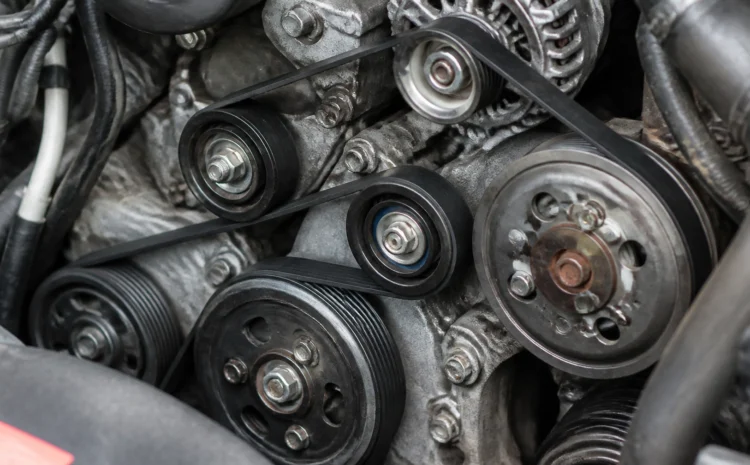
This is the long, winding belt you can see when you pop the hood. It’s the “workhorse” of your engine. As the engine runs, the serpentine belt spins, transferring power to multiple peripheral components. It keeps your battery charged (via the alternator), your cabin cool (via the AC compressor), and your steering easy (via the power steering pump). If this belt breaks, your car will quickly lose electrical power and begin to overheat.
The Timing Belt
Not every car has a visible timing belt (some use chains), but if yours does, it’s arguably the most critical component in the engine. It synchronizes the rotation of the crankshaft and the camshaft so that the engine’s valves open and close at the proper times. If a timing belt snaps while the engine is running, the valves and pistons can collide, often resulting in an engine that is totaled.
Why Milwaukee Weather Accelerates Belt Wear
We all know that Wisconsin weather is tough on our bodies, but it’s just as hard on rubber automotive parts. Rubber is sensitive to extreme temperature fluctuations.
In the winter, the freezing cold makes the rubber brittle. When you start your car on a -10°F morning, that cold, stiff belt is suddenly forced to spin at high speeds, which can cause micro-cracks. In the summer, the intense heat under the hood: exacerbated by Milwaukee’s high humidity: can cause the rubber to soften and stretch.
Furthermore, the road salt and chemical de-icers used on our streets can find their way into the engine bay. These chemicals can act as abrasives or even chemically degrade the belt material over time, leading to premature failure. This is why regular inspections are a non-negotiable part of auto repair in Milwaukee.
Warning Signs of a Failing Belt
The good news is that belts rarely fail without giving you a few hints first. If you’re paying attention, you can catch the problem during a routine oil change or check-up.
- Squealing or Chirping: If you hear a high-pitched screeching sound when you start the car or when you turn the steering wheel sharply, it’s usually a sign that a belt is slipping or the tensioner is failing.
- Visible Wear and Tear: Take a look at the “ribbed” side of the belt. If you see cracks, chunks missing (pitting), or fraying at the edges, the belt is nearing the end of its life.
- Heavy Steering: If your power steering feels “notchy” or suddenly gets heavy, the belt might be slipping on the power steering pump pulley.
- Battery Light: A failing belt might not spin the alternator fast enough to charge the battery, triggering the battery warning light on your dash.

The Dangers of a Broken Timing Belt
While a broken serpentine belt is a major inconvenience, a broken timing belt is a mechanical disaster. Many modern engines are “interference engines,” meaning the path of the valves and the pistons overlap. The timing belt is the only thing keeping them from hitting each other.
Because the timing belt is usually hidden behind a protective cover, you can’t easily inspect it yourself. This is where following your manufacturer’s recommended replacement interval is vital. Most timing belts need to be replaced every 60,000 to 100,000 miles. Ignoring this interval is a gamble where the stakes are the cost of an entire new engine.
Preventive Maintenance: The Sanfelippo Approach
At Sanfelippo Auto Repair, we believe in the “ounce of prevention” philosophy. During any standard service visit, our ASE-certified technicians perform a visual inspection of your belts and hoses. We look for the subtle signs of wear that an untrained eye might miss, such as “glazing”: a shiny, sleek look on the belt that indicates it’s been overheating and losing its grip.
With over 30 years of experience as a family-owned business in Milwaukee, we’ve seen exactly what our local climate does to vehicles. We don’t believe in “upselling” you on parts you don’t need, but we will always be honest when a $100 belt replacement today can save you from a $4,000 engine rebuild tomorrow.
Our team uses the latest diagnostic tools to ensure your belt tensioners and pulleys are also in good alignment, as a misaligned pulley can destroy a brand-new belt in a matter of weeks.
How Often Should You Replace Your Belts?
While every vehicle is different, here are some general rules of thumb for drivers in the Milwaukee area:
- Serpentine Belts: Usually last between 60,000 and 90,000 miles. However, because of our extreme winters, we recommend a visual inspection every year after the car hits 50,000 miles.
- Timing Belts: Strictly follow your owner’s manual. If it says 90,000 miles, don’t try to push it to 100,000.
- The “While You’re In There” Rule: If you are having your water pump replaced, it’s often smart to replace the belts at the same time, as the labor is already being done.
Conclusion
Your car’s belts are the unsung heroes of your daily commute. They work silently under the hood, ensuring your car stays cool, your battery stays charged, and your steering stays smooth. By prioritizing car maintenance in Milwaukee, you’re making an investment in your vehicle’s reliability and your own peace of mind.
Don’t wait for the sound of snapping rubber and a dead engine to take action. A quick inspection can be the difference between a smooth drive home and an afternoon waiting for a tow truck.
Is it time for a belt check? Contact Sanfelippo Auto Repair today and let our experienced team give you the peace of mind that comes with a well-maintained vehicle. We’re here to help you keep your car on the road for miles to come!