
Vehicle Diagnostics Matters: Why a Check Engine Light Needs More Than Just a “Code Scan”
We’ve all been there. You’re driving down I-94, minding your own business, when that dreaded little yellow icon: the “Check Engine” light: glows to life on your dashboard. Your heart sinks just a little bit. Is it a loose gas cap? Is your engine about to explode?
The modern driver’s first instinct is often to head to a big-box auto parts store for a “free code scan.” It sounds like a great deal, right? They plug in a tool, tell you the code, and sell you a part that they claim will fix it. But here’s the truth: a code scan is not a diagnosis. In fact, relying solely on a scan is one of the quickest ways to waste money on parts you don’t actually need.
At Sanfelippo Auto Repair, we believe in doing things the right way the first time. Let’s break down why professional vehicle diagnostics in Milwaukee are the only real way to protect your car and your wallet.
The Myth of the “Magic” Scanner
Let’s face it: there is a huge misconception that the computer in your car tells the technician exactly what part to replace. We wish it were that simple! In reality, your car’s On-Board Diagnostics (OBD-II) system is more like a witness to a crime than a judge delivering a verdict.
When a sensor detects that something is running outside of its normal parameters, it flags a Diagnostic Trouble Code (DTC). That code tells us which system is struggling, but it rarely tells us why.
For example, if you get a code for an “Oxygen Sensor Lean Bank 1,” many people assume they need a new oxygen sensor. They buy the part, install it, and two days later, the light is back on. Why? Because the sensor wasn’t broken: it was doing its job perfectly by reporting that the engine was getting too much air. The real problem might have been a cracked vacuum hose or a failing fuel pump.

The Medical Analogy: Thermometers vs. Doctors
To make this technical concept more digestible, think of your car like your own body. If you feel sick and realize you have a temperature of 102 degrees, the thermometer has done its job. It told you that you have a fever.
However, the thermometer can’t tell you if you have the flu, a sinus infection, or heatstroke. To figure that out, you need a doctor: someone who can look at your symptoms, perform tests, and use their expertise to find the root cause.
In the world of auto repair in Milwaukee, the code scanner is the thermometer. Our ASE-certified technicians are the doctors. We don’t just read the “fever” (the code); we perform the “physical exam” to find out what’s actually making your vehicle sick.
Why a Professional Diagnosis Saves You Money
It might seem counterintuitive to pay for a diagnostic fee when you can get a “scan” for free. However, professional vehicle diagnostics in Milwaukee is an investment that usually pays for itself. Here’s how:
- Preventing the “Parts Cannon”: When people guess which part is broken based on a code, they often end up “firing the parts cannon”: replacing component after component until the light finally stays off. This is expensive and frustrating.
- Pinpointing the Root Cause: A single symptom can have dozens of causes. Our team uses specialized equipment to test individual circuits and components to ensure we only replace what is truly broken.
- Catching Secondary Issues: Often, a fault in one system is being caused by a failure in another. If you only fix the symptom, the root problem will just break the new part again.
- Peace of Mind: Knowing that a professional has verified the repair gives you the confidence that your vehicle is safe for your family.
If you’re worried about your vehicle’s performance, checking our general maintenance page can help you stay ahead of these issues.

What Happens During a Real Diagnostic Appointment?
When you bring your car to Sanfelippo Auto Repair, we follow a rigorous process to ensure accuracy. We don’t just plug in a tool and walk away. Here is what our ASE-certified technicians actually do:
1. Retrieving the Data
We start by pulling the DTCs, but we also look at “Freeze Frame” data. This is a snapshot of exactly what the engine was doing the moment the light came on: how fast you were going, the engine temperature, and the fuel load. This context is vital.
2. Technical Service Bulletins (TSBs)
We check professional databases to see if the manufacturer has identified common “patterns” for your specific make and model. Sometimes, a check engine light just needs a software update, not a physical repair!
3. Visual Inspection
You’d be surprised how many “engine problems” are actually caused by a rodent chewing through a wire or a loose connector. We get under the hood to look for the obvious (and not-so-obvious) physical signs of trouble.
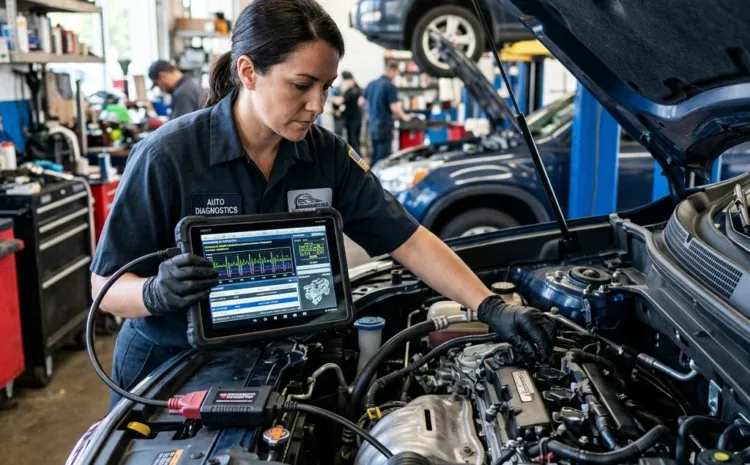
4. Specialized Testing
Depending on the code, we might use:
- Smoke Machines: To find tiny leaks in the intake or EVAP system.
- Multimeters: To test the electrical integrity of sensors and wiring harnesses.
- Oscilloscopes: To “see” the electrical signals the sensors are sending to the computer in real-time.
- Fuel Pressure Gauges: To ensure the engine is getting the right amount of “juice.”
5. Verification
Once we think we’ve found the problem, we test that specific part to confirm it has failed. We don’t guess; we verify. This is the hallmark of trustworthy engine and exhaust repair.

The Importance of ASE-Certified Technicians
The technology inside modern cars is mind-blowing. Most vehicles today have more computing power than the rockets that went to the moon. That’s why you can’t trust just anyone with your vehicle diagnostics in Milwaukee.
At Sanfelippo Auto Repair, our technicians are ASE-certified. This means they have undergone rigorous testing and have years of hands-on experience in the field. They understand the complex relationship between your transmission, your engine, and your exhaust system. When you choose an expert partner, you’re choosing reliability and long-term health for your vehicle.
Don’t Clear the Code and Hope for the Best!
One of the biggest mistakes drivers make is “clearing” the code (either by unhooking the battery or using a cheap scan tool) and hoping the light doesn’t come back.
Here’s the thing: clearing the code doesn’t fix the problem. It just deletes the evidence our technicians need to help you. It also resets your car’s “readiness monitors,” which can prevent you from passing an emissions test. If your light is on, leave it on and contact us so we can see the data as it happened.

Is a Flashing Light Different?
Yes! This is a critical distinction every driver should know.
- Solid Light: Your car’s computer has detected a problem. You should get it checked out soon, but it’s generally safe to drive to the shop.
- Flashing Light: This indicates a “Type A” misfire. This is a serious condition that can cause immediate, expensive damage to your catalytic converter. If your check engine light is flashing, pull over safely and stop driving immediately.
For those managing a business, keeping your vehicles on the road is even more critical. You can learn more about how we handle professional needs on our fleet services page.
Final Thoughts: Take the Next Step
A check engine light is your car’s way of asking for help. Ignoring it or settling for a “quick scan” is like putting a piece of tape over a “low fuel” gauge and hoping you don’t run out of gas.
At Sanfelippo Auto Repair, we’re here to simplify the complex. We provide honest, authoritative, and accessible auto repair in Milwaukee that focuses on the bottom line: keeping you safe and your car reliable.
Does your dashboard have a glowing surprise for you today? Don’t let the stress of the unknown weigh you down. Let our experts provide a real diagnosis so you can get back to your life with peace of mind.
Are you ready to find out what’s really going on under your hood?
Schedule your diagnostic appointment today and experience the difference that ASE-certified expertise makes.